
Insights and perspectives on the skills and competencies for management consultants.
Maria Silacheva
Dr Maria Silacheva is a Portfolio Manager for Siemens, based in Germany. She has Bachelors and Masters degrees in applied mathematics. She completed her PhD in 2014 and more recently completed her MBA with distinction at Durham University Business School.
Reproduced from the Management Consulting Journal, December 2019, Chartered Management Institute.
INTRODUCTION
The subject of skills and competencies for management consultants is on the radar of consulting firms, professional bodies and in texts on the sector (see, for example Caluwe and Reitsma, 2010 and Hodges, 2017). This paper draws on insights and perspectives that hopefully readers will find useful. It is not a comprehensive summary but one that nods towards the
practical, with references in place for people who wish to dive deeper.
PROJECT MANAGEMENT, ANALYSIS AND RELATIONSHIP-BUILDING SKILLS
Wickham and Wilcock (2016) argued that any consultant needs to be skilled in three areas, namely project management, analysis and relationship building. Project management skills are a vital component since consultants need to deliver projects. In this respect, Pinto (2015) specified the abilities to successfully manage budget, time, performance on objectives and client acceptance (see Figure 1). Moreover, Kaplan and Mikes (2012) highlighted the necessity to timely identify and appropriately address the risks.

Analysis skills are essential in the solution development process (see Figure 2). According to Prinsloo and Prinsloo (2018), analytical thinking is based on the ability to critically and rationally assess the facts, see interdependencies between components, apply linear- causal reasoning and make unbiased judgements.

As for relationship-building skills, they help consultants obtain key stakeholders’ support and manage the relationship dynamic throughout the consultancy lifecycle. Furthermore, they help ensure future collaboration. The major elements in this group of skills are the ability to build trust, effective communication and negotiation (Wickham and Wilcock, 2016).
Building and maintaining trust is often a great challenge for consultants since they have to deal with ‘learning- credibility tension’ which means they need to maintain perceived credibility at a high level while seeking information and learning (Bourgoin and Harvey, 2018).
Effective communication allows consultants to understand the organisational culture and politics and thus develop solutions that not only help improve the client’s competitive advantage but also are accepted and implemented. As Schein noted, a solution will only work if it does not contradict the organisation’s identity (Kuppler, 2015). To communicate successfully, consultants should choose appropriate channels, tailor the content to the audience, deliver the message in an understandable way and appear authentic and persuasive.
As for negotiation skills, they help manage a client’s expectations and are especially critical when aligning the project scope (Wickham and Wilcock, 2016).
ABILITY TO SELECT APPROPRIATE CONSULTING APPROACHES, ROLES AND BEHAVIOURS
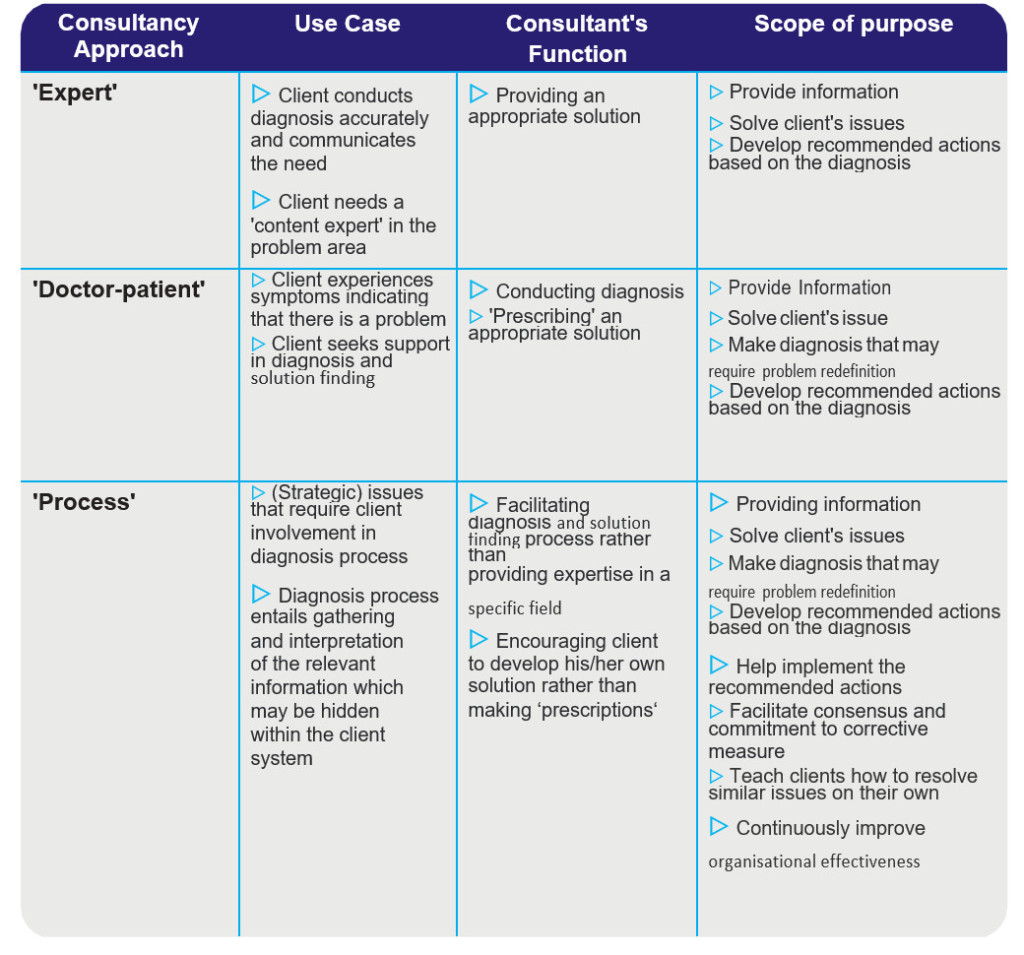
The purpose of consultancy, according to Turner (1982), may go far beyond just giving advice. Moreover, the scope of purpose, and thus the required knowledge and competencies, depend on the type of consultancy needed (see Table 1). Whereas expert consulting relies heavily on a deep knowledge in a specific area, process consulting seeks skills required to conduct the diagnosis and facilitate the solution development process. However, working on different projects during their career, consultants end up applying all three approaches and ideally, they should be able to select and apply the one responding best to the client needs (Schein, 1978).
The purpose of consultancy, according to Turner (1982), may go far beyond just giving advice. Moreover, the scope of purpose, and thus the required knowledge and competencies, depend on the type of consultancy needed (see Table 1). Whereas expert consulting relies heavily on a deep knowledge in a specific area, process consulting seeks skills required to conduct the diagnosis and facilitate the solution development process. However, working on different projects during their career, consultants end up applying all three approaches and ideally, they should be able to select and apply the one responding best to the client needs (Schein, 1978).
The idea of different consultancy approaches was expanded by Champion et al. (1990) who developed a ‘consulting role grid’ model (see Figure 3). It identifies the nine roles corresponding to various levels of a consultant’s responsibility for project results and for the client’s growth in terms of building capability to resolve similar issues without assistance. The roles differ by the degree of consultant’s intervention and thus require behaviours at a range of assertiveness levels involving activities.

Not only should consultants possess the required skills, but they should also understand the reasons why they were engaged by the client and choose the roles and behaviours that are most effective within the given project context. For example, often to surface the problems, they need to lead debates into an uncomfortable zone to question taken-for-granted
organisational beliefs (Bowman, 1995; Flip Chart Fairy Tales, 2010). Doing this requires a lot of experience
and social competence since the client is likely to show resistance and any poorly designed question may damage a consultant’s professional image.
CONSULTANCY QUALIFICATION?
McKenna emphasised that there is no formal qualification required for the consultant role (Levitt and Dubner, 2012). Moreover, companies in the consultancy sector are not interested in having an established body of knowledge since it may harm their competitive advantage. Nevertheless, there are institutions aiming at professionalisation of consultancy. For example, the International Council of Management Consulting Institutes (ICMCI) has developed a ‘competence framework’ highlighting three groups of competencies including business, technical, and values and behaviour (see Table 2).
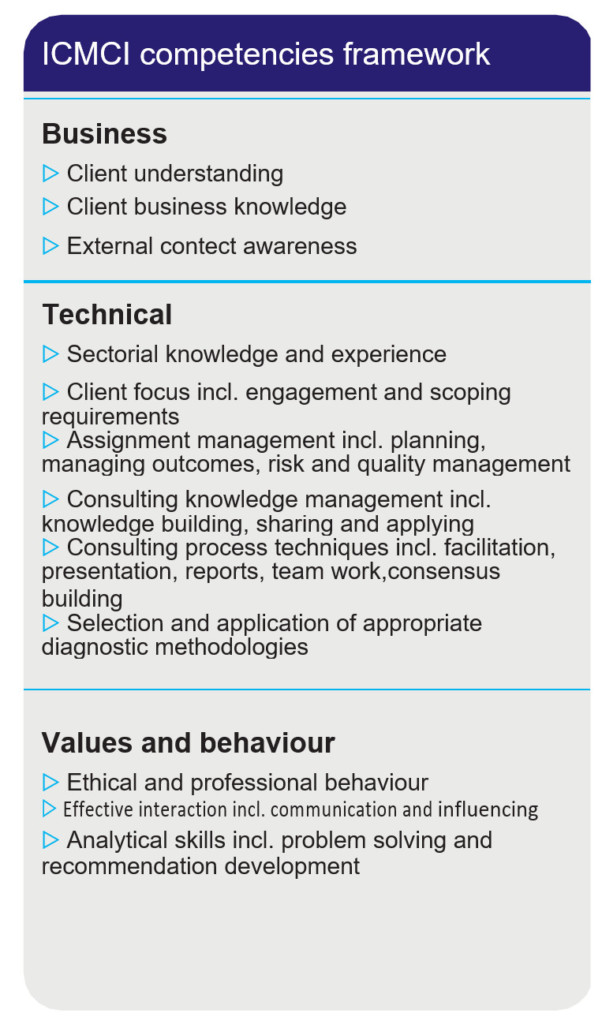
In my opinion, the framework, to a large extent, reflects the discussed areas of project management, relationship building and analysis. It additionally includes business knowledge and sectorial expertise that are vital in expert consultancy. Moreover, it highlights work ethics. Yet there is no clear emphasis on the consultant’s ability to choose behavioural tactics that are most effective in the given circumstances.
DEVELOPMENT OF CONSULTANCY COMPETENCIES
Knowledge creation and sharing are a basis for the development of the skills required of consultants. Given that knowledge is a key asset in consultancy organisations, they should put significant effort and resources into managing it effectively (Sarvary, 1999).
Knowledge types
I shall distinguish between two knowledge types, namely explicit and tacit (Nonaka etal., 2000). Explicit knowledge can be articulated, documented and stored in databases.
It includes, for example, consultancy frameworks and go-to-market methodologies. As for tacit knowledge, this cannot be communicated and documented easily. Such knowledge includes, for instance, handling local business issues. It is critical that knowledge management practices address both knowledge types (Summerhayes and Luo, 2006).
Skills development
To continually develop the consulting team’s knowledge, it is necessary to first establish a knowledge sharing process through which the already available knowledge is shared among team members. Additionally, to expand their knowledge dimensions, consultancy organisations should implement and execute a process for new knowledge creation by acquiring new knowledge from external resources and by creating it from scratch.
The methods organisations use to share knowledge among their professionals depend on the knowledge type. Explicit knowledge in consultancy organisations is normally integrated in their services (Summerhayes and Luo, 2006). Such knowledge is documented, so that consultants can gain it through formal educational programmes, and domain-specific training. For example, by this means, consultants can learn about market trends and various techniques and frameworks.
Yet, there is a gap between understanding the techniques and the ability to apply those effectively (Guzman, 2009). This gap is due to the tacit knowledge component. Given that tacit knowledge resides in individuals, it can be acquired by observing others practicing target skills as well as by practicing with or without supervision (Nonaka et al.,2000). Newcomers,before they start handling the tasks on their own, may first absorb practices by observing their peers. In this way, I believe one can learn how to effectively facilitate a solution development process using for instance the zone of uncomfortable debate method.
As for the new knowledge creation process, Nonaka (1994) developed a SECI (socialisation, externalisation, combination, internalisation) framework suggesting how tacit and explicit knowledge can be created and transferred within the firm (see Table 3).
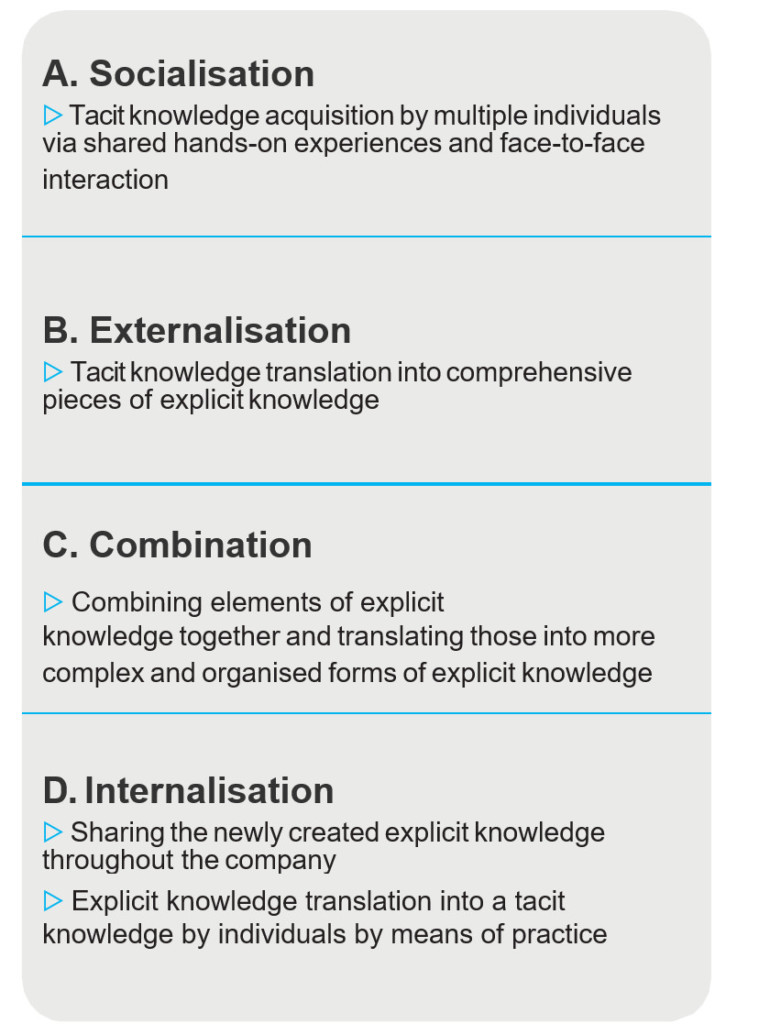
I believe for consultancy business, socialisation is the key element, as during this phase consultants acquire the latest knowledge from the third-party experts while participating in external workshops and forums. Consultants can also learn from clients and from temporary hired external professionals. As for the remaining three phases in the SECI model, they will ensure proper documentation and internal sharing of the newly acquired knowledge.
SKILLS OF CONSULTANTS VERSUS EXECUTIVES IN THE CLIENT ORGANIZATION
Client executives’ goal is making sure that the business delivers on stakeholders’ expectations and remains competitive. Ulrich and Smallwood (2007) suggested the five areas of leadership skills that, in my opinion, very well describe what effective executives should be able to do (see Table 4).

Comparing these skills with the consultants’ skills discussed above, one may notice a considerable overlap. For instance, both need to show personal proficiency, be able to drive change, execute and inspire people to collaborate. Moreover, executives similar to consultants need to be able to adapt their behaviour and leadership style according to the circumstances.
Yet, executives, who primarily focus on the specifics of their own organisation and its supply chain, may lack information concerning recent market development and new technologies. They may also be blind to certain aspects such as personal and organisational culture biases leading to decreased competitiveness and missed business opportunities. This is where consultants with their distanced view, state-of-the-art methodologies, latest market information and ability to identify and solve the problems can be useful.
However, multiple client organisations undertake to build internal consulting competencies by recruiting former consultants to fulfil managerial roles (Christensen et al.2013). This development led to a phenomenon called ‘management as consultancy’ which refers to managers adopting consulting practices while fulfilling their jobs as executives (Sturdy et al., 2016). Consultant managers are project-oriented, bring change, appreciate the external environment and play down hierarchy.
Sturdy et al. (2016) argued that management as consultancy may be a significant threat to external consultants as it decreases their differentiation potential. I only partially agree with this argument. Thinking of reasons why organisations use consultants, one may summarize those as follows:
- Lacking information and expertise to identify and/or solve a problem or seize an opportunity (e.g. strategic advice, operations improvement, help to implement change, provide market information),
- Temporarily required extra manpower,
- Use a consultant’s perceived objectivity to deal with organisational politics and overcome blocking coalitions (Worstall, 2012),
- Shift the responsibility in case of failure resulting from implemented change (Semadeni and Krause, 2011).
I think only the first reason is affected by the management as consultancy phenomenon. Furthermore, even though consultant managers can apply practices such as solution development process facilitation, it will be a great challenge to continually acquire the latest information about market development or emerging technologies crucial for the business. Therefore, management as consultancy is likely to impact process consultancy rather than expert consultancy business. Additionally, over time, consulting managers will lose the objectivity through long-term involvement in the business which will lead to a decreased ability to identify the problems.
CONCLUSION
Overall, each consultant should be able to master skills from the three categories, namely project management, relationship building and analysis. Besides possessing these skills, consultants need to be able to select the roles and behaviours to address the client needs in the most effective way. Doing so, they should act aligned with ethics and their values.
Successful development of consultancy skills requires a well-established knowledge sharing process that
includes both explicit and tacit knowledge transfer. This process in consultancy is characterised by the continuous involvement of external third parties for new knowledge acquisition.
There is a significant overlap between the skill sets required of consultants and client executives. Moreover,this overlap grows resulting from the management as a consultancy phenomenon. This creates a threat to consultancy firms due to their diminishing differentiation. Thus, to maintain their relevance, consultancy companies may need to shift focus from general strategy consulting to a more focused expert consulting and to move from effort-based to value-based pricing.
REFERENCES
Bourgoin, A. & Harvey J. F. (2018) ‘Professional image under threat: Dealing with learning-credibility tension’, Human Relations, 71(12), pp. 1611 – 1639.
Bowman, C. (1995) ‘Strategy workshops and top-team commitment to strategic change’. Journal of Managerial Psychology, 10(8), pp. 4-12.
Caluwe, L. de and Reitsma, E. (2010) Competencies in Management Consultants: a research study of senior
management consultants, in Consultation for Organizational Change, Buono, A. F. and Jamieson D, W. (eds) Information Age Publishing pp. 15-40
Champion, D. P., Kiel, D. H. & McLendon, J. A. (1990) ‘Choosing a Consulting Role’, Training & Development Journal, 44(2), p. 66.
Christensen, C., Wang, D. & van Bever, D. (2013) ’Consulting on the Cusp of Disruption (edited extract)’, Harvard Business Review, 91(10), pp. 106-114.
Davis, I., Keeling, D., Schreier, P., & Williams, A. (2007) ‘The McKinsey Approach to Problem Solving.’ McKinsey Staff Paper, (66)27.
Firmsconsulting (2012) ‘Consulting Interview, Kevin P. Coyne, former McKinsey Worldwide Strategy Practice Co-Leader’ [online] Available at: http://www.youtube.com/ watch?v=NFiqnlNocD8 / [Accessed on 5th December 2018].
Flip Chart Fairy Tales (2010) ‘How long can you spend in the ZOUD?’ [online] Available at: https://flipchartfairytales. wordpress.com/2010/06/10/how-long-can-you-spend-in-the- zoud/ [Accessed on 29th October 2018].
Guzman, G. (2009) ‘What is Practical Knowledge?’ Journal of Knowledge Management,13(4).
Hodges, J. (2017) Consultancy, Organizational Development and Change: A Practical Guide to Delivering Value, Kogan Page, Chapter 7
ICMCI (2013) ‘CMC Certification Scheme Manual Appendix 1 – CMC® Competence Framework’ [online] Available at: https://www.cmc-global.org/sites/default/files/public/CMC/ appendix_1_-specimen_cmc_competence_framework cmc002.pdf [Accessed on 19th December 2018].
Kaplan, R. S. & Mikes, A. (2012) ‘Managing risks: A new framework’. Harvard Business Review, 90(6), pp. 48-60.
Kuppler, T. (2015) ‘A Culture Discussion with Edgar Schein’ [online] Available at: https://www.youtube.com/ watch?v=kq9XL0N_fR0 [Accessed on 9th October 2018].
Levitt, S. & Dubner, S. J. (2012) ‘I Consult, Therefore I Am: A New Freakonomics Radio Podcast’ [online] Available at: http://freakonomics.com/podcast/i-consult-therefore-i-am-a- new-freakonomics-radio-podcast/ [Accessed on 5th December 2018].
Nonaka, I. (1994) ‘A dynamic theory of organizational knowledge creation’, Organization Science, 5(1), pp. 14-37.
Nonaka, I., Toyama, R. & Konno, N. (2000) ‘SECI, Ba and Leadership: a Unified Model of Dynamic Knowledge Creation’, Long Range Planning Journal, 33(1), pp. 5-34.
Pinto, J. (2015) ‘Introduction: Why Project Management?’ in Project Management: Achieving Competitive Advantage. 4th ed. Global Edition: Pearson Education Limited,pp. 21-49.
Prinsloo, M. & Prinsloo, R. (2018) ‘The Assessment and Development of Analytical and Systems Thinking Skills in the Work Environment’, Integral Leadership Review, 18(1), pp. 17-31.
Sarvary, M. (1999) ‘Knowledge Management and Competition in the Consulting Industry’, California Management Review, 41(2), pp. 95-107.
Schein, E. H. (1978) ‘The Role of the Consultant: Content Expert or Process Facilitator?’, Personnel & Guidance Journal, 56(6), p. 339.
Semadeni, M. & Krause, R. (2011) ‘Hired to be fired? Exploring top management team use of consultants as professional scapegoats’, Academy of Management Annual Meeting Proceedings, 2011(1), pp. 1-6.
Sturdy, A. J., Wright, C. & Wylie, N. (2016) ‘Managers as consultants: The hybridity and tensions of neo-bureaucratic management’, Organization, 23, pp. 184-205.
Summerhayes, K. & Luo, S. (2006) ‘Managing Knowledge in Professional Consultancy’, Monash Business Review, 2(3), pp. 1-13.
Turner, A. N. (1982) ‘Consulting is more than giving advice’, Harvard Business Review, 60(5), pp. 120-129.
Ulrich, D. & Smallwood, N. (2007) ‘building a Leadership Brand. (cover story)’, Harvard Business Review, 85(7/8), pp. 92-100.
Wickham, L. & Wilcock, J. (2016) Management consulting: Delivering an effective project. 5th ed. Harlow, England: Pearson.
Worstall, T. (2012) ‘Why Do Companies Hire Management Consultants’ [online] Available at: https:// www.forbes.com/sites/timworstall/2012/02/03/why-do- companies- hire-management-consultants/#2192fe2c2e4f [Accessed on 9th December 2018].